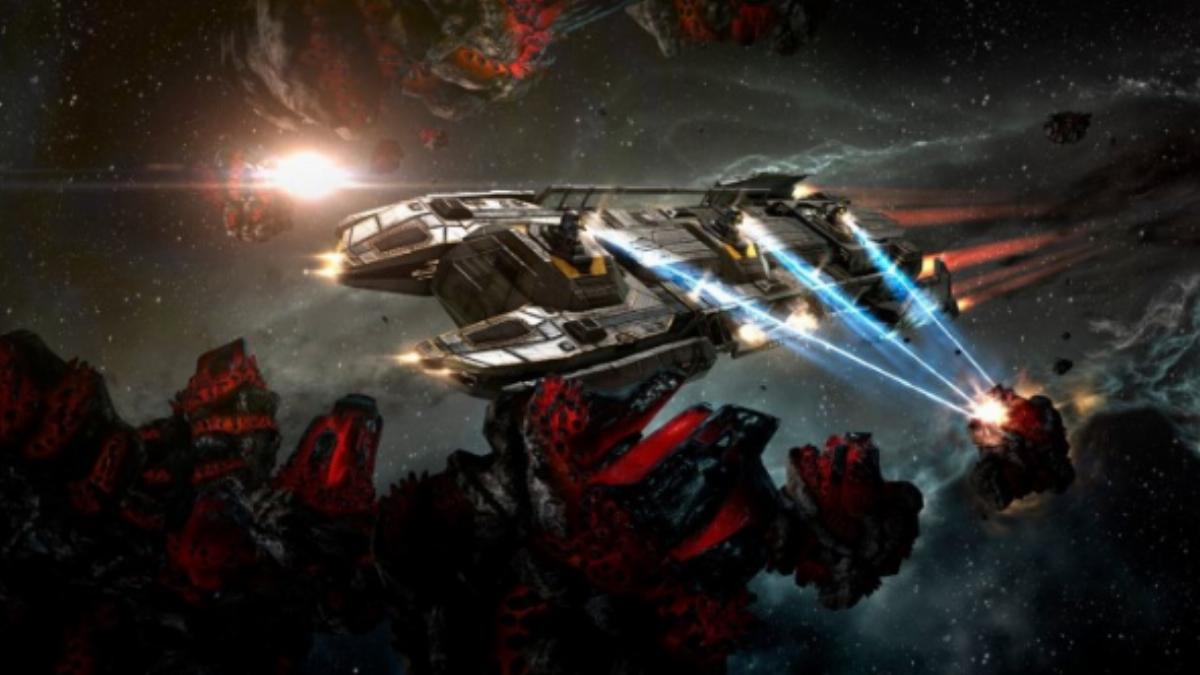
Biographical assistant’s note: This is only the introduction and summary of Professor en Thielles’ study projects while she was working on her Master’s degree. The full project notes and eventual presentation on “The Nature of Mercoxit and Morphite – Uses, Risks, and Feasibility” can be found in the archives at Caille University in Bourynes.

January 25th, YC98
Bourynes Campus – Caille University
One of the most interesting asteroids to drill into is Mercoxit, which is the only type of rock that will yield the rare mineral, Morphite. What makes it interesting (as well as rare) is the fact that it can only be found on the fringes of known space where pirates tend to lurk. Although, recently, there have been independent pilots and disenfranchised independents from all walks of life who are expanding into the “lawless” frontiers of space. I won’t get into that part of it here as my current lecture is about a particular rock and, by extension, the mineral.
Given how rare and how dangerous it is to harvest this particular asteroid type, you would think that it would drive the price of one unit of the ore up into the stratosphere. It is expensive in comparison to other asteroid belt or anomaly “rock” cluster resources but not more expensive than the ice type. The reason for this is that what it’s used for is equally rare and the demand for the ships and resources that use it aren’t very high.
While, yes, the miners who can mine this asteroid type do make a living from it, there are not many of them.
This keeps the economy for this type of rock stable.
Mercoxit requires specialized training. Normal mining lasers and strip miners are absolutely useless as the density of the rock is simply too high for even the strip miner, no matter what tier or complexity, to penetrate. It’s for this reason that mercoxit requires the specialized “deep core” lasers and strip miners which are notoriously slower to carve out chunks of rock, even regular types, but are the only type of mining harvester than can do the job. While certain crystals can make the drilling go faster (to a point) the density of the mercoxit slows down the process greatly. And, even after the miner has managed to carve a chunk (or “unit”, as the pilots refer to it) of the ore out of the asteroid, the density wreaks havoc in ore bays as it requires twice as much cargo space in an ore hold as arkonor or spodumain.
Most find the process tedious, even more tedious than the most patient of miners can even handle, and give up on mercoxit in favour of mining ice or the “ABC’s” of regular ore.
What risks are inherent in mining this type of ore?
Mercoxit mining has numerous and sizable risks, which an experience miner will be fully aware of and ready to mitigate. Outside of the usual risks of mining in the lawless fringes of space where the pirates fly ships capable of destroying anything smaller than a procurer and regularly raid the belts and anomalies, there are also threats from hostile pilots of alliances unfriendly to the alliance they are in… or are defending their claim from claim jumpers.. Those are risks all miners in “null sec”, where the asteroid is found, are used to.
There is, however, another risk outside of that… one that comes from the rock itself.
Mercoxit is a volatile and reactive rock which does not take well to the forces, or the disturbance, by mining lasers and strip miners… even the specialized deep core versions. This results in the occasional, and corrosive, cloud of dust and vapour being ejected from deep within the mercoxit asteroid and spilling out into the surrounding area of space. If a mining ship is too close to this cloud, the cloud will cause instant and then ongoing damage to armour and ship systems until the ship is moved outside of the cloud or the cloud dissipates. Most experienced miners of this ore have not only learned how to minimize these explosions and offgassing but also usually maintain a safe space between then and the asteroid, one where they are close enough to use their lasers or strip miners but not run afoul of the cloud.
What is it used for?
Mercoxit is the only ore that yields morphite, and it only yields that. Unlike other ores, there is no other byproduct outside of regular, and hard, slag which is about as useful as slag from any other ore. Miners after mercoxit know this and usually only care to compress the ore (removing enough of the slag to make transportation easier) in order to ship it to major trading hubs for quick sales. For the dedicated, the ISK they get in return is more than enough compensation to match the risk.
Morphite, for those with sufficient skill to reprocess the ore without losing too much of the valuable mineral into the slag pile, also yields near instant profit.
Outside of the immediate return in ISK, morphite is used in the building of the “Tier 2” advanced ship fittings (**except ‘rigs’) and not for anything else. Its primary purpose is to simply make normal components better components.
References:
Morphite – EVE Wiki
http://eve.wikia.com/wiki/Morphite
 Staring at Asteroids